Developers validating identifiers at the edge of a form, and teams building test fixtures who need numbers that are internally consistent without pretending to be anyone's.
How it works
- Paste a number to check; the table says which of the three conditions it meets.
- Read the row detail: what failed, both possible dates, and what the number discloses.
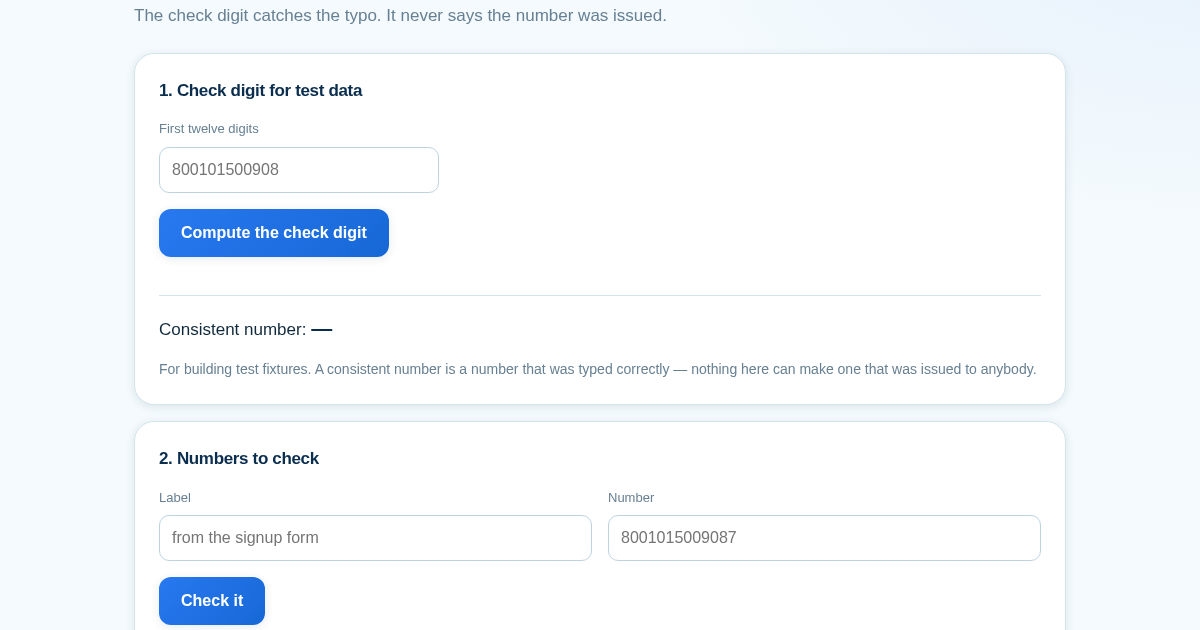
- Enter twelve digits to get the check digit that makes them consistent, for test data.
- Compare the thirteen-digit count with the fully-valid count - the gap is what a format check waves through.
What you gain
- Tells you when a number that passes every format check is still impossible — a consistent checksum with a birth date that cannot exist — before you rely on it as someone's identity.
Screenshot
Technical details
How to set up & use
- Buy the license — your key (lic_...) appears on the order page and in your email.
- Sign in at app.synoriaai.com with your license key.
- No installation — the product runs in your browser, on your own isolated instance.
- 1. Open the tool page and enter a 13-digit number in the input field.
- 2. Click the 'Check' button to see if the check digit matches and the date is valid.
- 3. Review the result: it will show whether the number is 'consistent' (checksum passes) and whether the date exists, including both century readings.
- 4. If you want to test a custom number, use the 'Add number' section to label and submit it for validation.
- 5. Use the 'Compute check digit' field to generate a check digit for a 12-digit prefix, and note the result is labeled 'consistent', not 'valid'.
Frequently asked questions
Does this tool verify if a number belongs to a real person?
No. It only checks internal consistency—the check digit and date plausibility. It does not access any registry or database, so it cannot confirm issuance or identity.
What does it mean when a number passes the checksum but has an impossible date?
The tool will flag it as inconsistent overall. A passing checksum only means the digits agree with each other; the date check is separate, and both must hold for a 'valid' result.
Is my input data stored or shared?
No. All processing happens locally in your browser; numbers you enter are not sent to a server or stored. The tool only performs arithmetic on the digits you provide.
Related products
Licence Triggers: the axis is distribution, not money
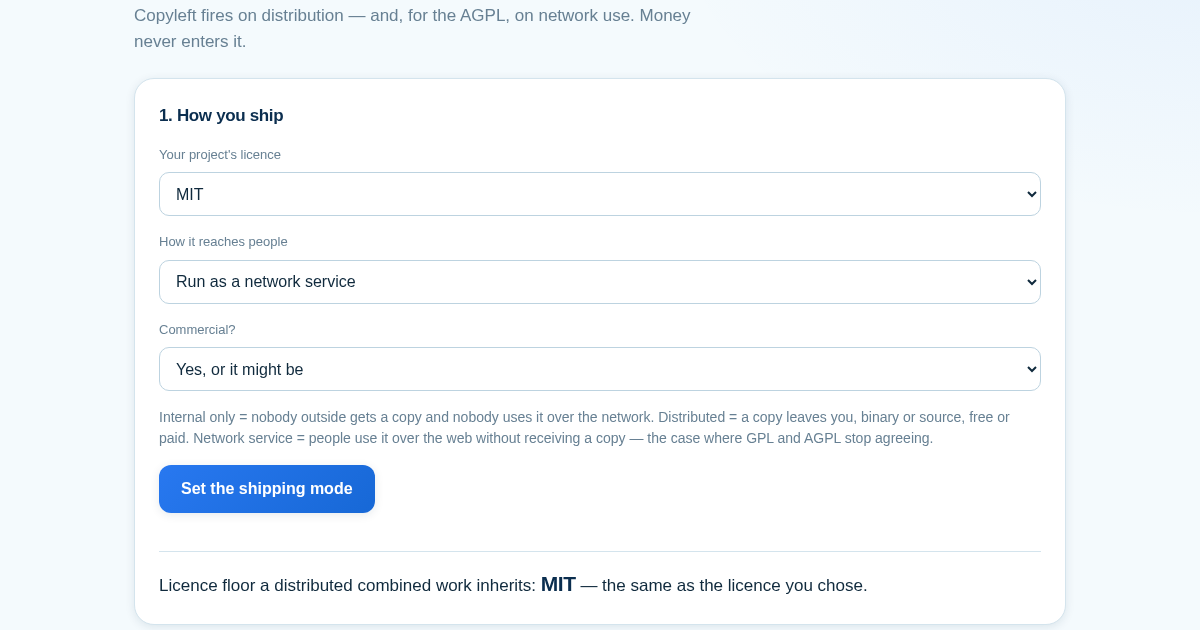
"It's a side project, I'm not selling it, so the licences don't matter" is the wrong axis. Copyleft is triggered by distributing a work - and, under the AGPL, by letting people use it over a network - never by charging…
Licence Triggers: the axis is distribution, not money
"It's a side project, I'm not selling it, so the licences don't matter" is the wrong axis. Copyleft is triggered by distributing a work - and, under the AGPL, by letting people use it over a network - never by charging…
Licence Triggers: the axis is distribution, not money
"It's a side project, I'm not selling it, so the licences don't matter" is the wrong axis. Copyleft is triggered by distributing a work - and, under the AGPL, by letting people use it over a network - never by charging…